Guide to the Chilean Education System: What Edtech Founders Need to Know to Start a Business in This Country
11 min read Impactus Ventures
If you already have an edtech startup or are thinking of starting a business with a pedagogical product, you should know that the education system in Chile offers great opportunities for creating and expanding startups, and for implementing solutions focused on teaching and learning processes for girls, boys and teenagers. The education system in Chile is one of the strongest and most developed in Latin America, although it faces challenges such as school dropout, which rose 25% in 2022 as a result of the pandemic, according to data from the Ministry of Education (Mineduc). Even with the education gap, Chile is an ideal market to start a business and raise the quality of education. That is why, at Impactus Ventures, we prepared a guide with the most important information you should know about Chile’s education model. The intention is for you to develop or adapt your product to the context lived in the country, considering the particularities of the education system.
Education funding and regulation
The first thing to consider is that, like Chile, each country has different education systems with its own rules and needs, although they all pursue the same goal: to deliver quality education to the children of the region.
In Chile’s case, the state is the great supporter of this whole system, and the country has a particularity: it is the only country in the world that funds public and private education in the same way, except for fully paid private schools.
It does this through a basic subsidy per student enrolled by the school. The Chilean state manages to sustain the different institutions across the country, creating market competition. The more students you attract, the more subsidy you will get.
In this sense, the range of institutions declared by Mineduc is divided into:
- Free: They receive mainly state funding and can be municipal or depend on local services.
- Subsidized with shared financing: They are funded by the state through a subsidy and by the monthly fee (financial contribution) paid by parents or guardians. Most of these institutions are private.
- Delegated administration: They operate through administration agreements signed especially with private-law entities linked to the business and industrial world.
- Fully paid private: They are funded entirely through monthly fees paid by parents and guardians.
Even so, students’ guardians play a fundamental role, since they must initially pay an entry enrollment fee, which gives your son or daughter the chance to study at the chosen institution.
Mineduc, for its part, is the body in charge of promoting the development of education at all levels, and also of ensuring a humanistic, scientific and artistic education, promoting the protection and growth of cultural heritage. It also proposes the public policies that institutions related to the state must carry out, although private schools must also be covered under the established regulations.
In Chile’s case, this whole system is regulated by Law 20.370, or the General Education Law, enacted on August 17, 2009, which establishes certain principles that will govern this system: universality and lifelong education, quality of education, equity, autonomy, diversity, responsibility, participation, flexibility, transparency, integration, sustainability and interculturality.
Structure of the education system
In the following table you can see in detail how the education system in Chile is divided.
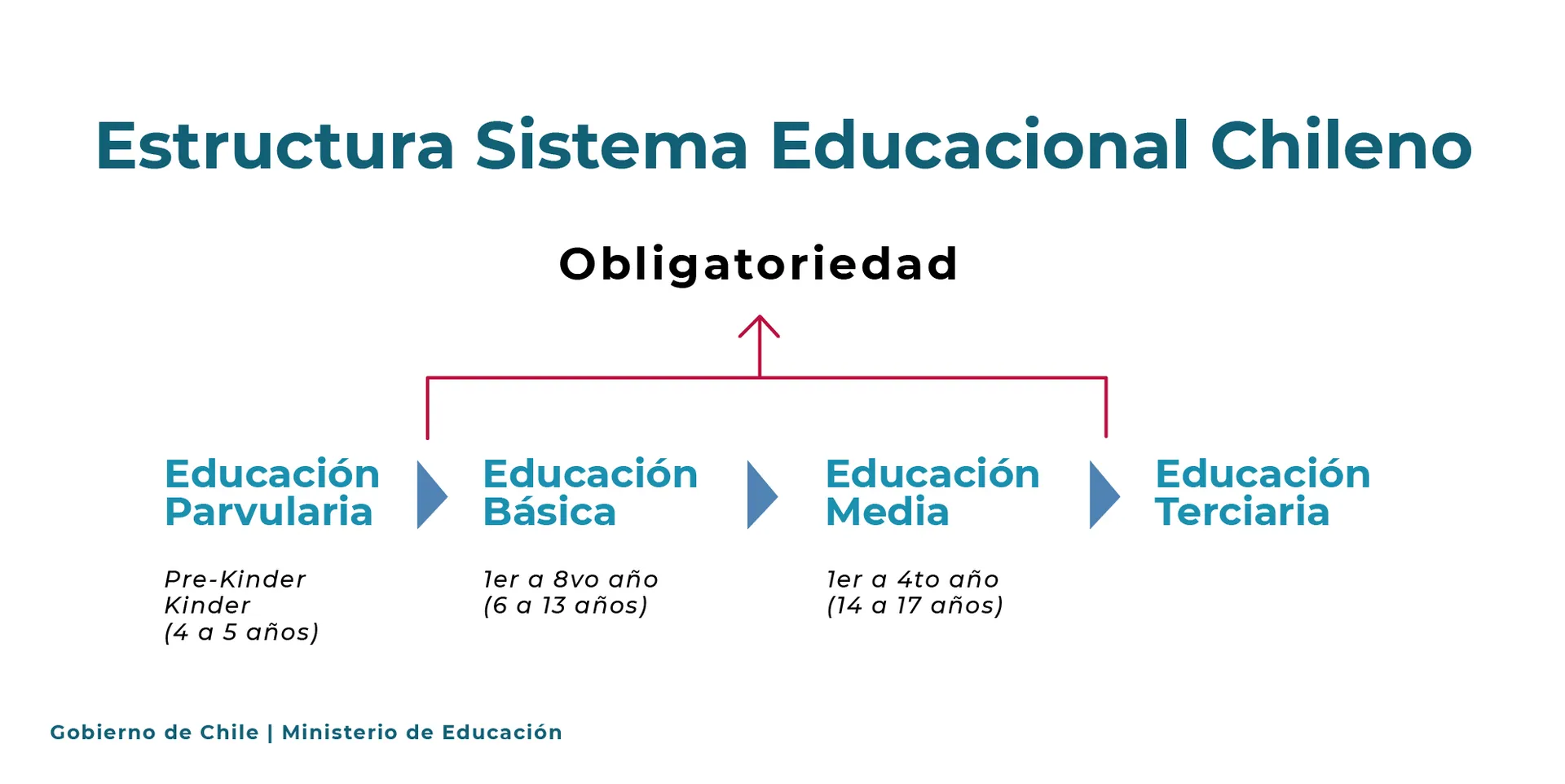
In this country, school teaching periods are divided by year, called “courses” (cursos). They usually run from March to December.
It has four basic pillars of teaching: early childhood education (parvularia), basic education, secondary education and higher education.
Education in Chile in the early childhood segment covers what is commonly called “kindergarten” (jardín) and starts at four years old, and can go up to five or six years old. Now, it is important to stress that this stage is not compulsory in Chile, so schooling can begin at the next stage. It is worth noting that in this phase children are not assessed, only a progress report is given to parents or guardians.
From six years old onward, education in Chile is compulsory, so it is the duty of parents, caregivers and the state to guarantee access to it. This stage of education is called “basic education” (enseñanza básica), and runs from first to sixth grade of basic. This is where assessments begin and the curriculum widens. Third, we find secondary education, which since a reform of Law 20.370 in 2010 includes the courses from seventh grade of basic to fourth year of secondary. Study hours usually increase and courses become specialized. Finally, higher education includes technical or university courses and, like early childhood education, it is not compulsory in Chile.
Schooling in numbers
According to the Mineduc Studies Center (CEM), in 2022 enrollment across the whole school system reached 3 million 644 thousand 536 students nationwide. According to the CEM, most enrollments are concentrated in subsidized private schools, 54.1% of total enrollments. In second place, with 30.6%, are municipal schools. Lastly, fully paid private schools account for 9.2%. The remaining percentage is split between the Local Education Service (4.8%) and the Delegated Administration Corporations (1.2%).
Another important fact is how enrollments are distributed by education stage:
- Early childhood education accounts for 9.7% (352 thousand 678 people)
- Basic education 56.3% (2 million 52 thousand 53 people)
- Secondary education 25.9% (946 thousand 768 people)
Now, regarding the concentration of enrollments by region, the top spot on the podium goes to:
- The Metropolitan region with 37.8%
- In second place, the Valparaíso region with 10.2%
- Lastly, the Bío Bío region, 8.8%
Areas of study
The areas of study in Chile, in basic education, are the following:
- Visual arts
- Natural sciences
- Physical education and health
- History, geography and social sciences
- English
- Indigenous language
- Language and communication / Language and literature
- Language and Culture of Ancestral Native Peoples
- Mathematics
- Music
- Guidance
- Religion
- Technology
Now, in humanistic-scientific secondary education, the curriculum is reduced a little:
- Arts
- Sciences
- Physical education and health
- Philosophy
- History, geography and social sciences
- Language and literature
- Mathematics
- Skills
First steps: early childhood education
According to the CEM, by August 2022 more than 700 thousand girls and boys had enrolled in preschool institutions, ranging from fully paid private kindergartens to those subsidized by the state.
All enrolled girls and boys will learn according to the Curricular Bases for Early Childhood Education (BCEP), which define the curricular guidelines for this education level and can serve as a complementary guide for starting a business if you want to intervene in the best way in children’s education. They state the objective of guiding the processes of comprehensive learning of girls and boys, from the first months of life until they enter basic education, highlighting the concept of comprehensive learning. In this way, early childhood education in Chile will focus on giving girls and boys the tools they need for their proper development throughout their whole school stage, in other words, laying the foundations for later learning.
Despite being a non-compulsory stage, the Chilean state guarantees access through the National Board of Kindergartens (JUNJI), which provides kindergartens according to the commune’s population, although there are also private kindergartens.
Basic education
The first compulsory level in this education system is called “basic education” and covers courses from 1st to 6th grade of basic, an approximate age range between six and thirteen years old, which as we mentioned earlier had more than two million enrolled in 2022.
According to the Basic Education Curricular Framework published by Mineduc, the first compulsory level of teaching in Chile is made up of various subjects, since from 2012 the following are considered: language and communication, mathematics, history, geography and social sciences, and natural sciences. From 2013 the subjects of visual arts, music, physical education, technology and guidance were added to the curriculum, in the same age range as the previous ones. In 5th and 6th grade of basic, English becomes compulsory. Since 1996, under the government of Eduardo Frei Ruiz-Tagle, the so-called Full School Day (JEC) was implemented. It provides for 38 hours a week, from 3rd to 8th grade of basic, adding up to 1,444 a year. The JEC also established that a “class hour” would be 45 minutes, although in schools the time used for each subject is usually an hour and a half, that is, two school hours.
This year, the Teachers’ Association of Chile sought to make this school day more flexible because of the difficulties of the return to in-person classes in all the country’s institutions. The Ministry of Education accepted this request and applied it from March to May 31, 2022, which resulted in a change in the hours girls and boys stayed at school.
This sets a precedent for changing the Chilean educational paradigm and also raises the question: how can education in the country evolve?
It is important to stress that, as a compulsory school period, the state must ensure access to it, and does so through its different “Bicentenario” schools (liceos) or by providing subsidies to institutions that need them. Although there is undoubtedly also the private option, supported by private parties.
These schools must also follow the guidelines provided by Mineduc, but with more freedom in how they focus teaching. From these initiatives come religious schools or schools with more teaching of other languages. Another feature is that these schools have their own support books for the teacher and do not necessarily have to use the books the ministry provides.
Secondary education
This third level, since the 2010 reform, covers the courses from seventh grade of basic to fourth year of secondary, and education becomes a little more specialized, making it more specific and with a higher level of demand.
A great example of this is that the sciences are separated, so we will no longer have natural sciences, and in their place there will be differentiated subjects with different schedules such as biology, physics and chemistry.
Also, from first year of secondary onward, music will no longer be compulsory. Even so, the art subject continues. A particularity of this teaching level is that, from seventh grade to second year of secondary, there will be 11 subjects in total and they are common, meaning all students take the same subjects for the same period of time.
You should know that in third year of secondary, elective subjects are taken, depending on which area of study you like most. The most common case in schools is scientific/humanistic, where the first increases hours of biology, physics and chemistry and the second increases hours of history and philosophy. Although there are certainly schools that choose to offer artistic subjects, such as painting and music.
The latter is meant to prepare students for the careers they want to enter, since after fourth year of secondary the Higher Education Access Test (PAES) is taken. However, there is also technical education in secondary education: educational institutes that teach subjects such as mechanics, accounting, administration, construction, and health and education, in order to better prepare them for one of the various paths in the last stage of education.

The last step: Higher education
Finally, higher education is the last step in this system, and like the first level, it is optional, and to enter it you must take the PAES (Higher Education Access Test), a test that replaces the well-known PSU and the brief PDT. In its debut as a transition test, the PAES had almost 300 thousand registrants. Depending on your PAES score, you can opt for different careers offered by the various universities and technical institutes in Chile.
Chilean universities are characterized by a mostly academic focus, teaching careers such as medicine, literature, law and physics, among many others. Technical institutes, meanwhile, offer careers with other focuses or points of view: computer science, nursing technician or gastronomy are frequent studies among Chile’s young people.
According to MINEDUC, by July 2022, 1.3 million students had enrolled in some higher education institution.
If you are an edtech founder and you are thinking of Chile as a destination to set up your operations, you should know that these challenges exist, but there are also possibilities for creating change. Take these considerations into account. Dare to create a positive impact!