3 Nonprofit Organizations That Boosted the Impact and Growth of the Childtech Challenge Winning Startups
9 min read Impactus Ventures

It is true that if you walk alone you will go faster, but if you walk with company you will go further. This is the case of the nonprofit organizations and educational startups focused on early childhood and youth that have decided to work hand in hand to impact more girls, boys and young people in Latin America.
To create a bridge of collaboration between the two sectors, the Childtech Challenge was created, a competition that looks for the world’s most innovative startups focused on childhood and youth, willing to implement their solutions in vulnerable communities.
To find the best nonprofit organizations that take part in this competition and carry out the rollout with the winning startups, a search is run that prioritizes those with a recognized track record in childhood and youth, with the desire to incorporate innovation and technology into the interventions they carry out.
Once the winning startups have been selected, these organizations are in charge of leading the implementation of the winning solutions in the vulnerable communities where they operate. In this way, the impact of their programs is accelerated thanks to their broad experience, as well as the experience each of the winning startups brings.
But that is not all. The winning startups manage to reach vulnerable communities that would otherwise be very hard to reach. The joint work between social organizations and startups has made it possible to impact more than 25,000 girls, boys and young people since we started the Childtech Challenge in 2021, and we want to keep growing!
We invite you to learn about the work of three organizations that have taken part in this competition as implementation partners, and that innovated hand in hand with the startups that won in past editions of the Childtech Challenge.
1. Fundación Familias Power
You have surely heard this phrase many times: “Education starts at home and is complemented at school.” But what happens when children’s parents do not have the foundations or resources to raise and educate them properly? Children lack appropriate early development and grow up with fewer opportunities.
Fortunately, Fundación Familias Power works so that this no longer happens. For 16 years, this foundation has worked with the families of preschool children in vulnerable areas of Chile. It teaches them early stimulation activities, games and reading tasks so that the little ones reach their full cognitive, social and emotional development.
A group of experts visits these families’ homes directly so that children receive quality early education. “We do not replace any school or kindergarten. We are an important support in education work in terms of reading, writing and bonding with caregivers,” says Vivianne Traub, director of administration and finance at Fundación Familias Power.
The purpose is to empower families because parents become the first educators and homes the first schools; they are the first space where children grow. Vivianne also explains that children arrive at primary education with a very large lag in social, emotional and cognitive skills, which worsened with the pandemic.
The foundation uses social innovation and technology in the educational programs it develops to face the problem. For example, it implemented Afinidata, a chatbot that guides parents with early stimulation activities so that their children have appropriate child development. This edtech won the first edition of the Childtech Challenge in 2021, so the foundation helped it enter the Chilean market and get families using its platform.
“It was a rewarding experience. We reached 1,100 families with the help of Fundación Familias Power in Chile, where we had no presence, and we got important partners in the country and other regions,” says Andreana Castellanos, founder of Afinidata.
For Vivianne, the value of collaborative work between organizations and startups is that each adapts to the other’s needs to accelerate impact. “We pushed Afinidata to build a much more robust platform, and they helped us be more scalable, generate savings in programs and make them more attractive to donors,” says Vivianne.
To give you an idea of the impact it is having on childhood, in 2023 alone its help reached 3,500 families in 108 communes across 10 regions in Chile. It built alliances with 48 schools, delivered almost 40,000 books and educational toys, and ran more than 56,000 personalized educational sessions with families. Incredible!
You can learn more about the foundation here.

Photo courtesy of: Fundación Familias Power (Facebook)
2. Fé y Alegría Colombia
The purpose of this organization is to create better opportunities for children and young people with limited resources in Colombia to go to school. It is part of Fé y Alegría International, a federation for education and social promotion with a presence in more than 22 countries in Latin America, Europe and Africa. Since its founding in 1955, it has benefited more than 900 thousand students with limited resources and 40 thousand workers, including teachers, educators and administrative staff.
In Colombia it has early childhood programs that it runs together with mayors’ offices and the Colombian Institute of Family Welfare (ICBF). It has 20 children’s centers where children between two and five years old receive quality education based on an educational model that the organization itself developed, grounded in popular education.
But that is not all. Dora Pino, early childhood coordinator at Fé y Alegría Colombia, explains that the organization provides 70% of the food children receive, while the other 30% comes from their parents at home. In addition, according to Dora, they also have training programs for parents in which they provide tools and training so children can have better parenting.
The government takes part in all this work with financial resources, human talent and teachers, nutritionists, institutions such as the Medellín Institute of Sports and Recreation (INDER) and startups like Storybook. This company won the Childtech Challenge 2022, an achievement that let it implement its solution in Fé y Alegría’s preschools. It is a platform of stories, music and infant massage to improve the quality of sleep and the socio-emotional development of girls and boys.
“Fé y Alegría helped us reach another market and gave us the educators’ view to see how our product could help them or how we could improve it,” says Catalina Aboy, Marketing Partnerships Lead at Storybook.
Its technology helped the organization innovate, face the problems experienced by low-income Colombian children and bring quality early education to more children and families.
Thanks to the use of social innovation in education, the organization has been able to reduce educational lag. In 2021 it impacted 162 thousand Colombian girls, boys and teenagers, and in 2022 it benefited 10 thousand early childhood girls and boys. You can learn more about the organization here.
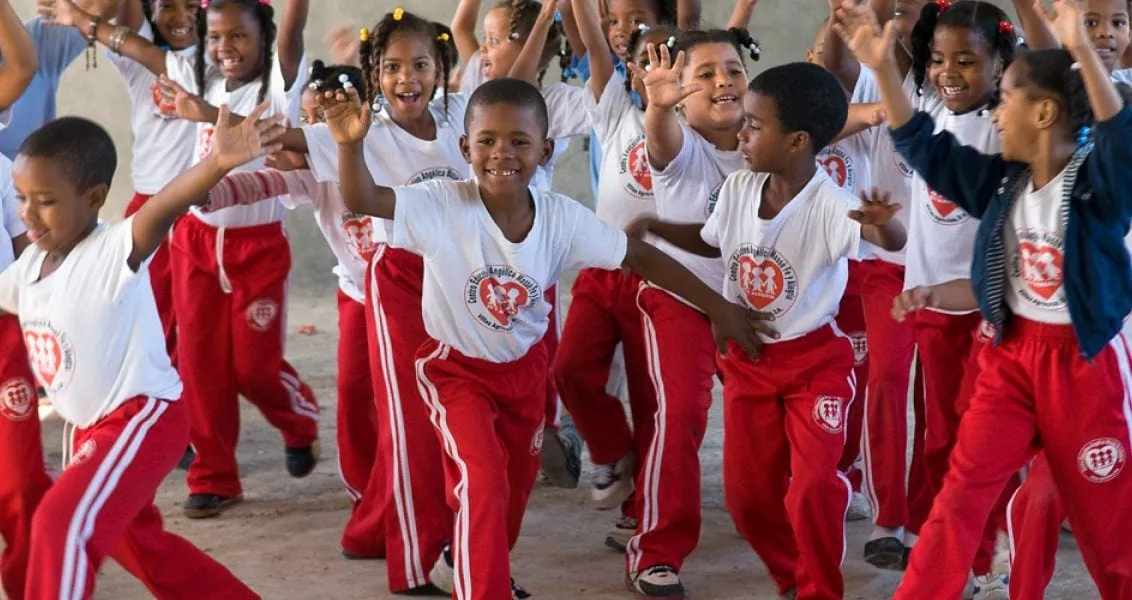
Photo courtesy of: Fé y Alegría Colombia
3. Cafam
This is another organization that fights the lack of access to education and educational lag in Colombia. Besides being a family compensation fund with 64 years of experience, it also works so that more girls, boys and young people in vulnerable areas can go to school and have better opportunities in the future.
How does it do it? Cafam has different educational programs so that the children of workers affiliated with the compensation fund receive quality education and food support. This organization has its own private schools and has formed alliances with the state to manage some public schools, where it teaches its own educational methodology, which has let it prepare students with the skills they need for the jobs of the future.
“For us the knowledge the student gains is important, but also that they are clear that there are important skills they must develop in their school life, which have a direct effect at university,” says Carlos Castro, Technology Coordinator at Cafam. Carlos says that most students trained at Cafam manage to get into the country’s best universities.
This organization works with early childhood, K-12, higher education students and also adults. The impact Cafam has achieved in its more than 50 years is very large. For example, in 2021, 250 thousand people benefited from the education programs. More than 34 thousand people have gotten a job at a company through the job placement program, and more than six thousand students are being trained in Cafam schools.
This organization stays open to integrating new innovative, technology-based educational solutions to impact more people and improve teaching and learning practices in Colombian schools. For this reason, it took part in the second edition of the Childtech challenge in 2022, choosing the startup Matific to implement its math educational platform in four schools in Bogotá. Currently more than 2 thousand Colombian students learn math by playing with this tool.
“At the pedagogical level there is a very important input that the platform provides, and that is the data it produces in real time on student performance by content and skills,” says Carlos. “We can cross that data with the results we get from standardized tests and the assessment schemes we run internally. That way teachers can adjust topics to meet educational needs,” he adds.
This implementation is still under way in schools in Colombia. “Cafam handles the organization and work in schools. They do the follow-up on the ground, organize training, logistics, devices and everything needed for the project to continue. This synergy lets us detect challenges and risks in time and overcome them,” says Paula García, Partnerships and Projects Manager at Matific in Latin America.
Fé y Alegría Colombia, Fundación Familias Power and Cafam are an example of the high level of expertise and knowledge that the nonprofit organizations taking part in the Childtech Challenge as implementation partners have.