Discover Three Pioneering Latin American Foundations Developing Science and Technology-Based Products
9 min read Impactus Ventures

These institutions fight for better living conditions in the region through social innovation and the development of science and technology-based products. Find out how they have done it.
Social organizations play an important role in the development of the most vulnerable population in Latin America and the Caribbean. They create better opportunities for the future and combat the most serious problems in the region through social innovation, programs, support and nonprofit initiatives.
They address several problems, of which three stand out. The first is extreme poverty. Latin America and the Caribbean remains one of the regions with the highest poverty rates in the world. More than 86 million people live in this condition, according to data from the Economic Commission for Latin America and the Caribbean (ECLAC).
The second social challenge is the education gap. The quality of learning remains stagnant in the region. For example, 60% of sixth-grade primary school children do not have minimum levels of reading and math skills, according to the United Nations (UN). And finally, the third problem is the lack of opportunities and social inclusion experienced by the 19 million girls and boys with disabilities in Latin America, according to UNICEF figures.
Fortunately, there are social organizations addressing these social challenges that have also dared to innovate by using technology to accelerate their social impact. For this reason, here are three success stories of nonprofit organizations that are innovating socially, and that have created technology-based products with social impact to improve the living conditions of people living in vulnerable situations.
Inoma: Educational games for learning

How can you create a social impact in basic education in Mexico? That was the question that led Antonio Purón to found Inoma in 2011, after working many years in the education sector. He realized that children at the base of the pyramid in vulnerable situations were not being served with quality education, which is key for them to be more competitive and develop in the future.
Inoma is a nongovernmental organization made up of educators, psychologists and project managers. Together they develop innovative tools with playful and educational purposes for girls and boys between 6 and 13 years old. The organization’s goal is to raise the quality of learning and for the little ones to achieve competencies such as mastering technology, problem solving and teamwork.
Noticing the areas of opportunity in education, Purón innovated by developing an educational video game app called Tak Tak Tak, which lets students learn, complement and reinforce their knowledge. To date this technology has more than 850 thousand users from Mexico and other countries such as Ukraine.
Purón explains that although the platform is aligned with the primary-level curriculum of Mexico’s education system, it stands out for its ability to measure children’s academic performance and suggest the video games that best fit their needs thanks to the use of predictive algorithms.
But that is not all. The organization also developed LabTak, a platform for parents, teachers, schools and school systems where they can check students’ educational performance through automatically generated reports. Inoma’s innovation lies not only in creating these tools, but also in improving teaching and learning processes by complementing curricula with these supporting applications.
Some specialists understand innovation as new ways of creating value and making improvements even to an existing project, product or solution, as was the case with Inoma. Purón agrees with this idea, although he points out that the use of technology is also important because it allows scalability and attracts users at lower cost. “We have to rely on technologies that are spreading deeply to speed up the learning curve and take advantage of their reach,” adds Purón.
This organization has managed to sustain itself through donations and funding with Purón’s own resources. Another way of generating income is through the cost recovery achieved by implementing Tak Tak Tak and LabTak in public primary schools, as well as fitting out media classrooms and training teachers on how to use these tools.
If, like Inoma, you also want your social organization to be sustainable, Purón recommends looking for a source of income that can be permanent, or the support of organizations and sponsors that can fund the creation of technology solutions and their implementation in the market. As for developing innovations, Purón says: “Break the status quo, question the way things are done, and test solutions to see if they really work in the market.”
Fundación Capital: Boosting families’ economies
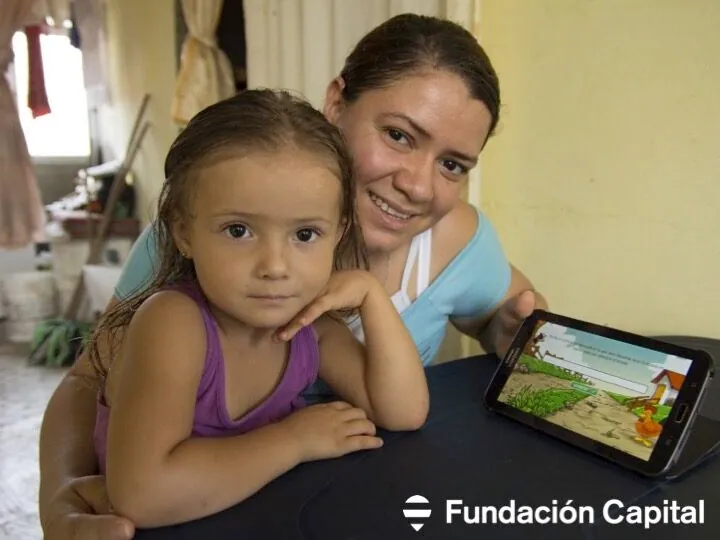
This is a nonprofit social enterprise with a presence in Asia, Africa and Latin America, which seeks to improve the economic and financial lives of people living in extreme poverty. To achieve this, it has developed different initiatives such as the Graduation Program, aimed at families in Colombia led by women and young people in vulnerable situations. They are part of the 7.4 million Colombians who live in extreme poverty, according to data from the National Administrative Department of Statistics (Dane).
The Graduation Program provides access to knowledge, psychosocial support services, entrepreneurship training, coaching, financial services and an economic incentive for families to start a productive activity that lets them generate income to get by. Through this economic inclusion program, the foundation innovated socially by implementing a methodology that makes it possible to understand and tackle poverty from different dimensions, not only from the lack of capital.
The foundation also uses technological innovation to impact children, young people, women, migrants and refugees. For example, to complement the Graduation Program, they developed Apptitude and Igualdapp, two mobile apps to teach topics of financial inclusion, entrepreneurship, women’s leadership, socio-emotional skills, and sexual and reproductive health through videos, animations and audio.
“We developed these solutions to improve the quality of the training we provide. In fact, the foundation has a very strong digital innovation component that we have brought to the programs we run,” says Carolina de Miranda, director of the Social & Livelihood Promotion department at Fundación Capital.
This foundation has managed to stay active and carry out both the implementation of its projects and the development of its solutions thanks to funding from multilateral bodies and international donors. Although de Miranda says they have been looking for private investment to leverage their digital products and depend less on philanthropic donations.
To social leaders who are looking for new ways to make an impact, de Miranda suggests developing tools taking the end user’s profile into account, and validating them in the market. In fact, Fundación Capital has invested in testing, developing and iterating its solutions. To social entrepreneurs she recommends building synergies with other players in the ecosystem to achieve greater reach. “Let’s think of social innovation as networked work, with a vision of changing systems, instead of doing simple projects. It can create more sustainability and scalability,” says de Miranda.
Fundación Prótesis 3D: For the social inclusion of children

Improving the quality of life and achieving the social inclusion of girls, boys and teenagers with disabilities is the engine that has driven the work of Fundación Prótesis 3D. It is a Chilean institution that makes and donates custom prostheses to people who do not have the financial resources to buy them.
Unlike other solutions, these devices are made from recycled materials, and young people deprived of liberty take part in making them through a social program run with the support of the National Service for Minors (now Mejor Niñez). So far the foundation has delivered more than 400 prostheses.
When Daniela Retamales, co-founder of the foundation, began this innovation together with her brother, they believed the most important part was the functionality of the prostheses. However, they realized that the biggest problem is the social exclusion and discrimination that people with disabilities come to suffer.
60% of these people said they felt wronged and discriminated against in the Regional Perception Survey for the Job Inclusion of People with Disabilities by Universidad San Sebastián. For these people, “prostheses create a change in perspective, not only for themselves, but also in how the rest of society sees them,” says Retamales.
The co-founder says they have had several innovation and technology developments, and have pivoted several times to perfect the prostheses, as well as running tests directly with end users and researching materials and manufacturing. They even received support at the beginning from the organization Enabling the Future for the creation of their first designs and models.
They are currently developing prostheses with built-in sensors that let people carry out work activities more easily. Retamales and her brother decided on this innovation after noticing that people with disabilities are often turned down in job interviews because of the activities they cannot do.
For this innovation, they gathered information to find out what functions the prostheses should have. Reviewing the user experience has also been key in creating these solutions, since according to Retamales, it makes it possible to detect failures and areas of opportunity and find a way to add value.
Another important part of the foundation has been the business model. Although it has tried different ways of getting income to sustain itself, most of its funding comes from donations by companies, as well as social investment it has received from foreign funds. In fact, the foundation plans to diversify its source of income by launching an introductory course on 3D-printed prostheses, designed for occupational therapists and people in the rehabilitation field.
Retamales’ recommendation for social leaders who, like her, seek to improve and impact people’s lives is to design solutions always keeping the user at the center of everything. “It is important to find out the real needs of the user you are addressing, and to assess the technical, cost and market feasibility the innovation can have,” says Retamales.
These organizations have managed to impact thousands of people with innovation and technology. They are an example of how you can make improvements in your organization to accelerate and increase the impact you seek to create.
Are you part of, or do you know, other success stories of social organizations that have developed technology-based products? We want to meet you! Leave us your details here and we will contact you.