The 10 Finalist Startups of the ChildTech Challenge 2022
7 min read Impactus Ventures
Meet the companies that are transforming education, emotional health and the development of children, teenagers and young people with innovation and technology.
For the second year in a row we ran the ChildTech Challenge, an initiative that recognizes and rewards the most promising startups with technology-based solutions for the benefit of children, teenagers and young people in Latin America and the Caribbean.
We identified global entrepreneurs who are contributing to better child development and learning, through innovative value propositions and scalable business models.
But we did not do it alone: United Way joined us on this adventure. Both the organization and Impactus Ventures seek to be pioneers and managers of innovation and entrepreneurship programs with high social impact in Latin America.
This year we launched the ChildTech Challenge together with Fundación FEMSA and +Global from Fundación Mustakis, our main allies, who were also part of this initiative in the first edition of the contest held in 2021.
After several months of planning, we set out to find the best ChildTech startups. The result of the call could not have been more successful: we received applications from 26 countries in Latin America, North America, Europe, Asia and Oceania.
We discovered talented, innovative and passionate founders committed to positively impacting the lives of children, young people, and mothers and fathers.
The 10 finalist companies were chosen by a committee of experts after a long evaluation process. Aspects such as the efficiency of the solution, innovation, scalability, the problem it solves and social impact were taken into account, according to the two types of challenges to solve (categories): socio-emotional skills, and inclusion and education.
These are the finalist startups of the ChildTech Challenge 2022. Learn about their value proposition, country of origin and how they are transforming people’s lives.
Finalists of Challenge 1: Socio-emotional skills
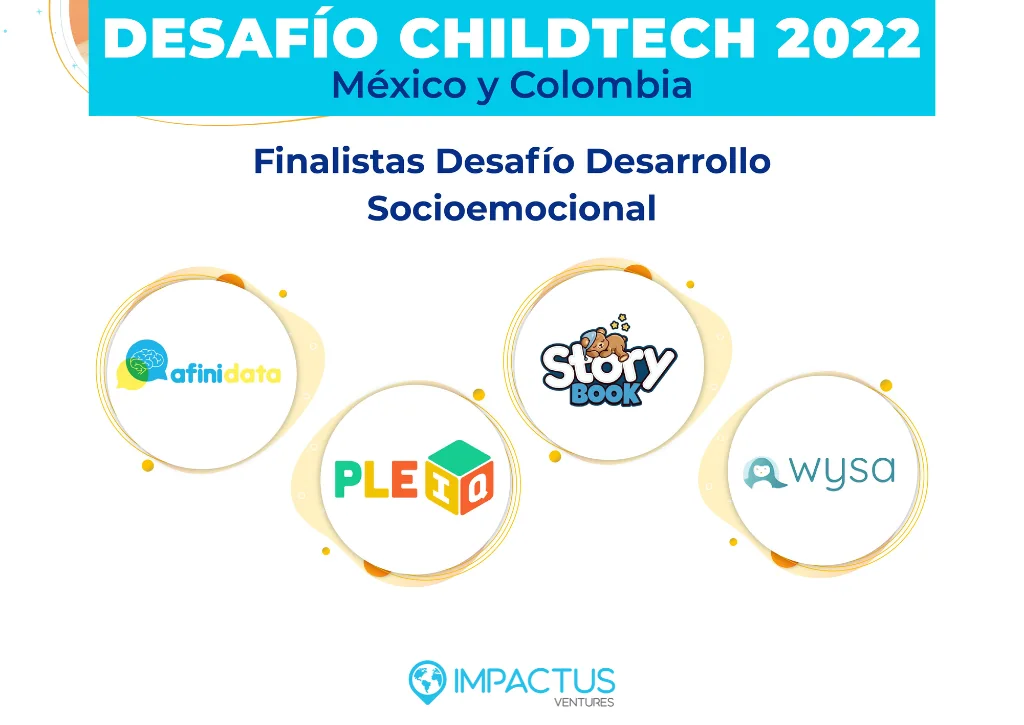
Storybook (Ecuador)
The startup was founded by Daniela Vega and Francisco Cornejo, who developed a sleep and wellbeing app for children with a subscription scheme. Its solution helps little ones fall asleep through bedtime stories, combined with music and relaxation techniques such as meditation and infant massage.
Unlike other solutions, Storybook physically involves mothers and fathers in the process, since it lets them spend quality time with their children before bed, build genuine emotional bonds and encourage the little ones’ sleep.
Afinidata (Guatemala)
This company drives the development of children under six years old through early stimulation educational activities. Afinidata’s greatest competitive advantage lies in the technology it uses, since it relies on artificial intelligence and a chatbot that interacts with parents to give them weekly educational content.
The algorithm of the platform created by Andreana Castellanos can learn from each child, and with the information it collects it can recommend to parents the most suitable activities for their children’s development. Access to these educational resources is obtained through a subscription scheme.
PleIQ (Chile)
Under the concept of learning by playing, PleIQ fosters learning in dynamic and fun environments with the help of digital toys and interactive notebooks with augmented reality. This educational tool has become an alternative to awaken children’s interest in learning.
Its founder is Edison Duran, who developed this product with a focus on learning in eight areas: linguistic, logical, naturalist, visual, musical, kinesthetic, intrapersonal and interpersonal. All the platform’s content was designed with the curricular bases for early childhood education in mind.
Wysa (India)
Fighting mental health problems such as depression, anxiety and stress is the purpose of Wysa, a startup founded by Ramakant Vempati. How does it do it? Through an artificial-intelligence chatbot, teenagers, young people and adults receive specialized care to raise their emotional wellbeing.
Thanks to this assistance, users can reflect, feel heard, stay calm, develop healthy habits and put both their thoughts and feelings in order. The artificial-intelligence-guided service offers scalable, evidence-based, anonymous and clinically safe care through a paid scheme.
Finalists of Challenge 2: Inclusion and education
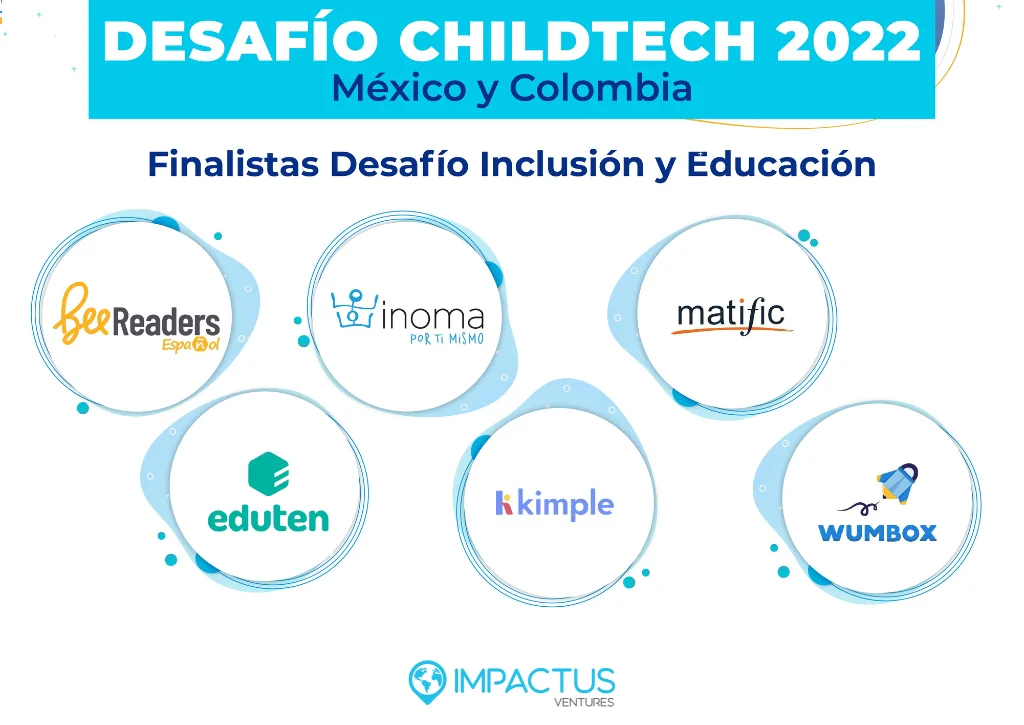
Wumbox (Argentina)
This is an adaptive learning platform with thousands of interactive educational resources for students from 3 to 14 years old. The tool, created by Agustín Pardo, makes it easier for teachers to teach in school classrooms and for students to learn through play.
Unlike other solutions, Wumbox measures and analyzes the user’s interactions in real time and then adapts its educational resources to children’s needs. In this way, the company ensures personalized, high-quality learning.
Beereaders (Chile)
This company wants both children and young people to read more and improve their reading comprehension in a playful and safe environment. To do this, Rubén Arias and Luis Gringas, founders of Beereaders, developed a platform for students, educators and parents with a library of original Spanish-language content such as books and texts.
One of its big advantages is that it can be used without being connected to an internet network, a quality that makes it an easily accessible tool, even in areas without web access. With this solution, the company is redefining how reading is learned inside and outside school classrooms.
Eduten (Finland)
Math is one of the most complicated subjects for early-stage students. To make it easier to learn and understand, Marta López de Mäkinen, Henri Muurimaa, Erkki Kaila and Makke Leppänen, co-founders of Eduten, designed a platform with a content library that includes more than 200 thousand gamified tasks adapted to curricula.
The company uses artificial intelligence to personalize learning experiences, calibrate difficulty levels and provide learning analytics for teachers. In this way, students can improve their math skills through a digital teaching and learning system.
Matific (Australia)
This is another company that is changing the approach to teaching math. Matific’s big bet is to create an educational environment that gives children the foundations to do better at math for life, beyond just helping them pass an exam.
Its platform uses game-based principles to encourage students to learn through discovery, all aligned with school curricula. It has more than 2 thousand interactive activities, worksheets, workshops and assessments to keep students engaged, both at school and at home. The startup was founded by Raz Kupferman and Shimon Schocken.
Kimple (Spain)
Pina de Paz, founder of Kimple, developed a platform that includes educational content and learning dynamics that teachers can use in their classes to improve their teaching method.
All the content follows the Sustainable Development Goals (SDGs) set by the United Nations (UN) around three main pillars: computational thinking, global citizenship and entrepreneurial spirit.
The platform works on different skills and competencies such as teamwork, creativity, critical thinking, responsibility and commitment, communication and flexibility, among others.
Inoma (Mexico)
The mission of this nonprofit organization, founded by Antonio Purón, is to provide playful, educational digital tools to improve the academic performance of children between 6 and 12 years old in vulnerable regions.
Inoma has two platforms: Taktaktak, with educational video games on math, reading, grammar, spelling, science, values, economic inclusion and the arts; and Labtak, a site for teachers with access to a library of high-quality pedagogical content and a learning community.
A promising future
Now these companies will have to prepare for the final stage of the award, where the founders will present their pitch at the Demo Day, after which the winning startups will finally be chosen.
It is worth noting that the 10 finalist startups will receive soft landing workshops and will be considered for other commercial scaling projects, with investment possibilities in Latin America. In addition, the winning companies will receive a services contract for up to 30 thousand dollars to implement their solution together with social organizations in Mexico and Colombia.