Guide to the Mexican Education System for Startups Looking to Expand to That Country
8 min read Impactus Ventures
One of the biggest challenges faced by startups focused on school education when planning to expand is understanding how the education system works in the countries they want to reach**.** If you are considering Mexico as an expansion destination, you should know that the Mexican education system is one of the largest and most complex in all of Latin America.
For this reason, in this article we want to help you with the task of analyzing and understanding the Mexican education system at the levels of preschool education and school education in Mexico. Below we cover the main aspects you should know.
Education regulation
The first thing to keep in mind is that the body responsible for the regulation of the education system in Mexico is the Ministry of Public Education (SEP, for its Spanish name). It is a federal entity and its headquarters are in Mexico City.
This institution is in charge of designing, coordinating and carrying out public and private policies on education. Under this body’s management, the educational plans, projects and programs that must be applied at all education levels are controlled.
There are also state-level Education Secretariats. These are run by the SEP’s General Coordination of Federal Delegations, and are present in the country’s 32 delegations.
General structure of the Mexican education system
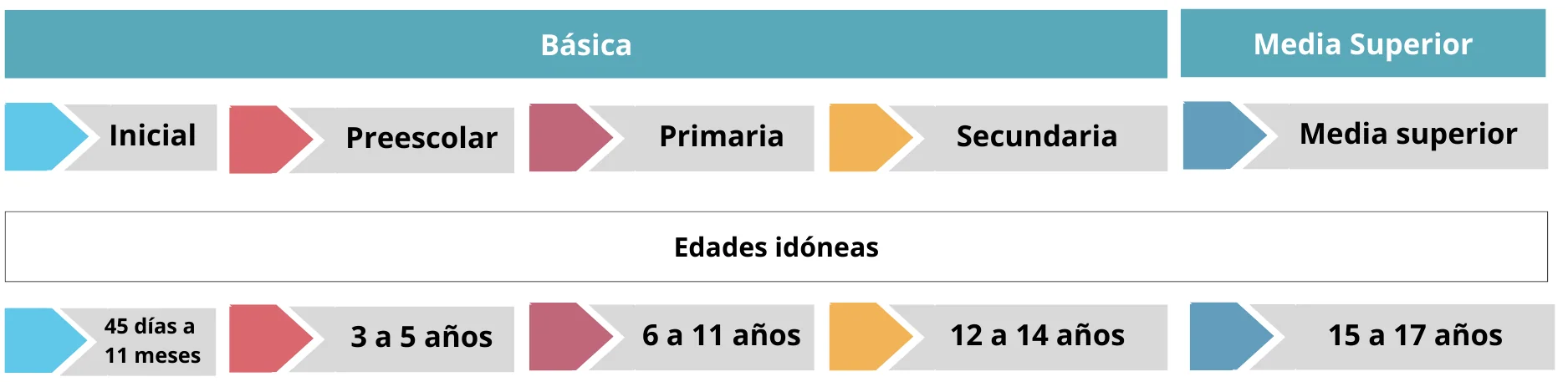
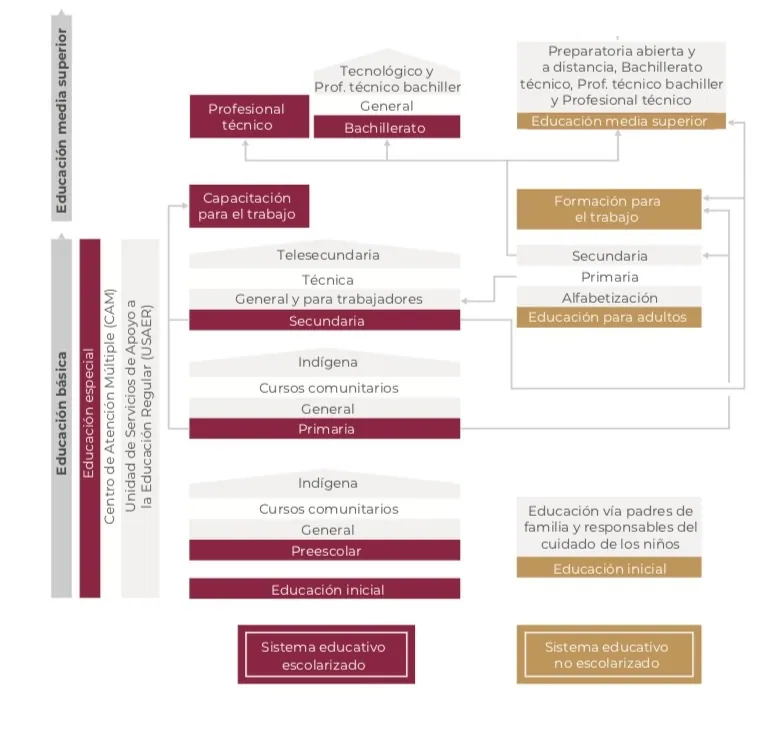
In the following image you can see in general how the Mexican education system is made up, and the population covered by each school level.
Source: Ministry of Public Education
As you can see, the system has two education types: Basic and Upper Secondary. The SEP defines them as follows:
Basic education
This is the first compulsory education level and covers the largest number of years of schooling. It is made up of the levels: initial (general and Indigenous), preschool (general, Indigenous, community courses), primary (general, Indigenous, community courses) and secondary (general, technical and telesecondary). The age ranges for these levels are: initial from 45 days to 2 years 11 months, preschool from 3 to 5 years; primary from 6 to 11 years, and secondary from 12 to 14 years.
Upper secondary education
It includes the levels of high school (bachillerato), technical professional high school and their equivalents, as well as professional education that does not require high school or its equivalents. The typical age group for this education type is 15 to 17 years.
Subsystems by education type
Within each education type there are levels and subsystems, among which the general one stands out for having the largest number of students, and the Indigenous one for being bilingual and bicultural.
Source: Ministry of Public Education
There are two teaching modes: school-based, which has an in-person format, and non-school-based, which has a distance format.
Lastly, grades start in primary school and correspond to:
- Primary education covers 1st to 6th grade (children between 6 and 11 years old).
- Secondary education covers first, second and third grade (between 12 and 14 years old).
- Upper secondary education covers 3 school years and comprises 6 semesters (between 15 and 17 years old).
Subsystems in upper secondary education
The upper secondary education system in Mexico aims to train students with the skills needed to access Higher Education and the job market.
That is why it promotes developing research, communication and critical thinking skills, as well as aptitudes that enrich their ability to make decisions that improve their quality of life.
The upper secondary education system has 3 subsystems:
- General high school: It consists of a curriculum of basic and core subjects that prepare students to continue their studies at the higher level. Some of the subjects in this area are math, Spanish, social sciences, natural sciences and philosophical and artistic disciplines. Most upper secondary students are in this subsystem.
- Technological high school: It offers training focused on effective entry into the job market. It includes subjects specific to the professional career to be developed, for better academic and hands-on preparation.
- Technical professional: A more developed education level that gives students higher-level training, but with a short duration of about two years. Students earn a technical bachelor’s degree, with which they can legally work in the job market.
Students and educational institutions
According to the National Institute of Statistics and Geography (INEGI) in the National Survey on Demographic Dynamics, 32.9 million people between three and 29 years old enrolled in the 2020-2021 school year.
According to the SEP analysis “Main Figures of the Education System 2019-2020,” the number of students by education type and of schools across the country is as follows:
Number of students by education type:
- Basic Education (3 to 14 years): 25 million 253 thousand 306
- Upper Secondary Education (15 to 17 years): 5 million 144 thousand 673
Number of schools and campuses nationwide:
- Basic Education: 230 thousand 424
- Upper Secondary: 21 thousand 47
The states with the most schools and campuses are the State of Mexico, Veracruz and Chiapas, according to the latest census by the National Institute for the Evaluation of Education (INEE).
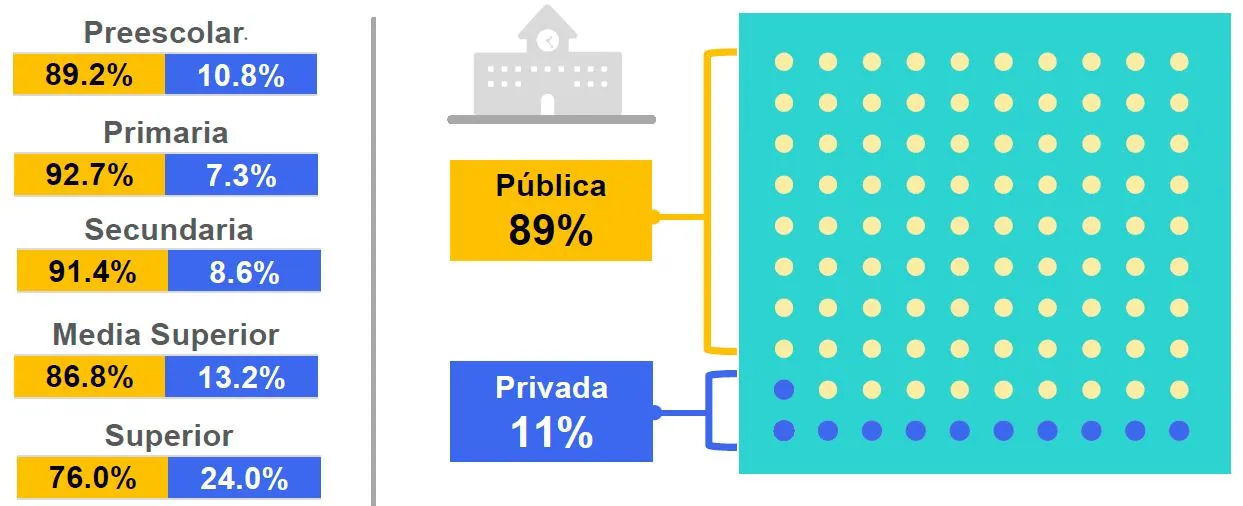
Another important fact to consider is that in Mexico education is both public and private. Of the total student population at the basic and upper secondary levels, only 14.5% belong to private institutions in the school-based mode. If we consider the whole education system including higher education, this figure is 11%.
In summary, we can see the distribution by education level as follows
Source: INEGI
Educational challenges
Mexico, like most Latin American countries, faces various social challenges in education. One of them is school dropout.
There is currently a significant number of girls, boys and young people who have dropped out of the school system and abandoned their education. The dropout problem gets worse as levels or grades advance.
Likewise, as people’s age increases, so does the proportion who leave school. According to the SEP, in the 2019-2020 cycle only 53% of students graduated from upper secondary education in the school-based mode.
The education gap is another of the big problems facing Mexican education. It is a factor that has historically been driven by economic inequality and access to educational opportunities in the most vulnerable communities.
This has been made especially worse by the pandemic and remote classes. In the country, less than half of the population has access to technology or the internet at home, so distance education quickly turned into a complete educational shortfall. According to INEGI data, only 44.3% of households have a computer, while 54.4% have internet access.
According to INEGI, 2.3 million people between three and 29 years old did not enroll in the 2020-2021 school year. Why? Because of reasons directly tied to the COVID-19 pandemic, and 2.9 million for lack of money or resources.
In addition, the number of students between three and 29 years old who were enrolled in the 2019-2020 school year but did not continue or dropped out of the education system in the 2020-2021 cycle because of the pandemic or lack of financial resources was 1.8 million. Most were from public schools, with 1.5 million compared with 243 thousand from private schools.
The pandemic also left other challenges for the school population, such as the high levels of stress and anxiety caused by prolonged confinement. The most serious cases of these disorders occur in poverty settings, where children have found themselves in overcrowded conditions and highly vulnerable to violence and domestic abuse.
In the meantime of remote classes, a large share of the school population has started other daily practices and activities such as unskilled jobs. This is a risk factor, since it could cause millions of children not to return to in-person classes and join the dropout population.
Entrepreneurship, key to the development of education
Now you know. If in your expansion plan you are considering Mexico as an option to start operations, it is important that you analyze the education system so you can adapt your model and value proposition. That way you will have a better chance of entering the Mexican market successfully. As you have seen, education in Mexico has areas of opportunity that entrepreneurs can take advantage of to raise educational quality in the country’s classrooms. Dare to create change in the education of millions of children and teenagers!
Sources: INEGI and the Ministry of Public Education (SEP)