Education System in Colombia: A Guide for Startups Planning to Expand to This Country
9 min read Impactus Ventures
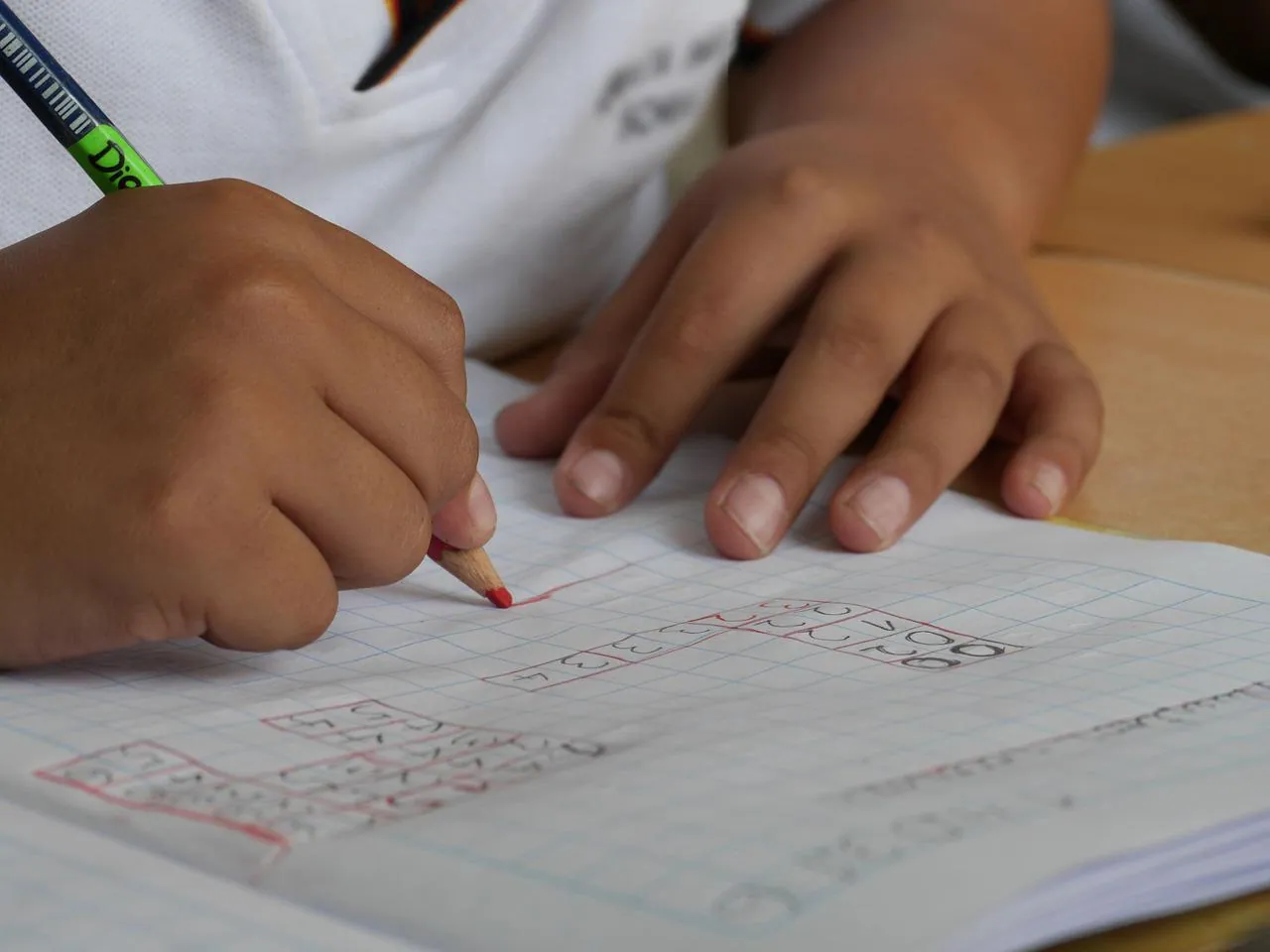
One of the biggest challenges faced by Colombian girls, boys and teenagers is the low quality of the education system in Colombia, along with little or no access to technology resources in rural areas. This is pointed out by the United Nations Children’s Fund (UNICEF) and Colombia’s Ministry of Education.
Education in Colombia is an area of opportunity with potential for implementing educational projects and startups focused on learning during childhood, considering that the country has a student population of almost 10 million girls, boys and teenagers.
It is a market opportunity for your startup, but before doing so, you should know how the education system in Colombia works so you can achieve a successful soft landing in this market. Below we explain 4 important points you should know.
1. Education regulation
In Colombia, the education system is regulated by the Ministry of Education, which is in charge of formulating national teaching policies, regulating and setting educational quality criteria, and advising departments, municipalities and districts on all aspects related to learning.
The Colombian Ministry of Education has two main offices, both located in the city of Bogotá. From there, the operations of regional local offices and educational institutions across the country are managed.
At each school and educational institution, rules are governed by a Governing Council, an Academic Council and a Rectorate. These make up the internal organizational structure.
The legal regulations of education in Colombia are governed by the General Education Law, which was originally issued in 1994, but has had several reforms and adaptations of its articles. This law covers everything from the scope and purposes of the national education service to the administrative organization of each education level.
2. General structure of the Colombian education system
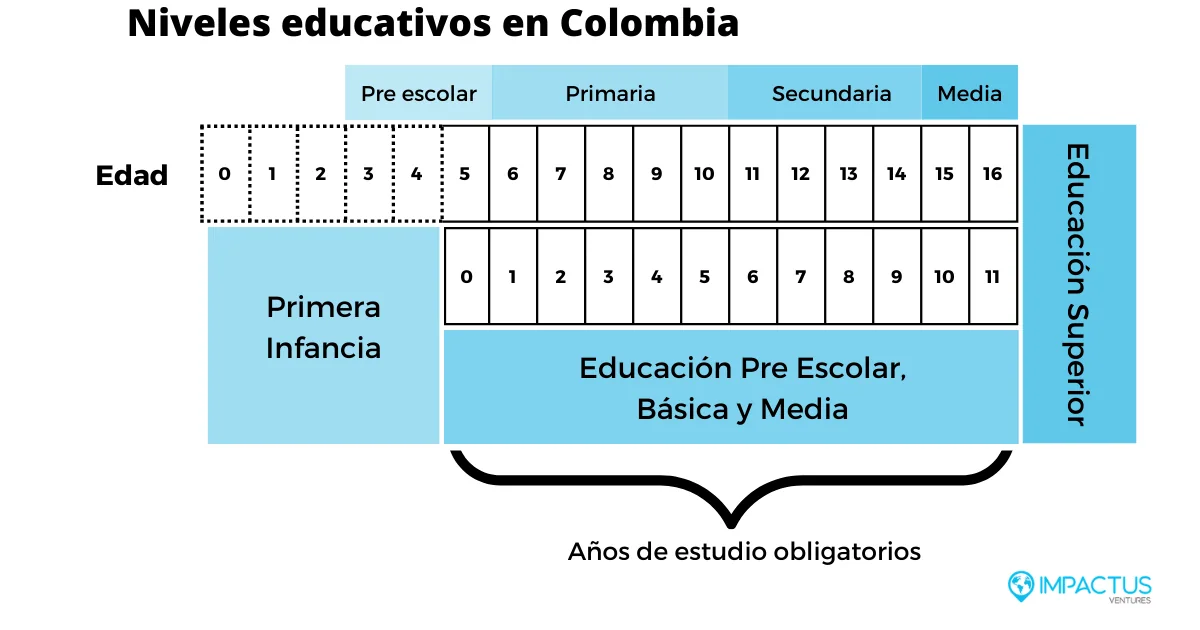
The Colombian education system is structured in grades that last one year and have specific objectives to be met.
Education in Colombia is classified as formal and informal, depending on how it is delivered.
The formal sector is made up of 5 education levels:
- Initial education (ages 3 to 5)
- Preschool education (ages 5 to 6)
- Basic education (5 grades of primary and 4 grades of secondary, from age 6 to 15)
- Upper secondary education (from age 15 to 17)
- Higher education (from age 18 onward)
The levels are compulsory through upper secondary education.
The compulsory training areas defined by law are:
-
Natural sciences and environmental education
-
Social sciences
-
History
-
Geography
-
Arts education
-
Ethics education
-
Physical education
-
Religious education
-
Humanities
-
Spanish language
-
Foreign languages
-
Mathematics
-
Technology and computer science

3. Characteristics by education level
A. Initial education
This is the first education level for children and is delivered in institutions known as kindergartens, which are subsidized by state or private funds. This education level is aimed at children between 3 and 5 years old.
At this first stage, work and training are carried out together with children’s parents and relatives. Learning social norms is promoted, and at the same time children are given the tools to continue to the next education levels more independently and autonomously.
B. Preschool education
This education level is made up of a single grade considered a transition between initial education and basic education. It is aimed at 5-year-old children**.**
Although subjects are not failed at the preschool level, the first qualitative assessments of the child and of the fulfillment of educational parameters or objectives are carried out. This is part of a personal descriptive report that will serve parents and teachers for the following school grades.
C. Basic education
This is the broadest level of education, since it covers 9 continuous years of schooling. Here, children begin to develop skills and knowledge in the basic school subjects, and improve their verbal communication and analytical logical reasoning.
As for institutions authorized to deliver basic education, all are required to have an Institutional Educational Project (PEI), which specifies the strategies proposed to fulfill the mandates of the education law, adapted to the context and needs of each school.
Basic education is made up of two cycles:
- Primary: It consists of five grades, named first to fifth. It starts at age 6 and ends at age 11.
- Secondary: This cycle consists of four grades, named sixth to ninth. It usually starts at age 12 and ends at age 15.
D. Upper secondary education
This level includes the tenth and eleventh grades. Once this cycle is completed, students graduate with the title of academic bachelor or technical bachelor depending on the training received. It is aimed at young people between 15 and 17 years old.
Academic upper secondary education focuses on deepening students’ knowledge in a specific field, whether in science, humanities or the arts. The purpose is to have a good base to continue with university studies.
Technical upper secondary education, for its part, focuses on developing skills to practice a trade or work in production and service sectors.
4. Students and educational institutions
According to the National Administrative Department of Statistics (DANE), in 2020 the national enrollment of students in the preschool, basic and upper secondary education levels was 9 million 882 thousand 843 people.
The distribution of students by education level is as follows:
- Preschool (age 5): 928 thousand 947 students
- Basic primary (ages 6 to 11): 4 million 169 thousand 781 students
- Basic secondary (ages 12 to 15): 3 million 439 thousand 531 students
- Upper secondary (ages 16 to 17): 1 million 344 thousand 584 students
According to DANE data, the departments with the largest enrolled student population in the preschool, basic and upper secondary levels are:
- Bogotá (1 million 174 thousand 274 students)
- Antioquia (1 million 149 thousand 861 students)
- Valle del Cauca (839 thousand 566 students)
- Cundinamarca (610 thousand 367 students)
- Atlántico (546 thousand 055 students)
Of the whole population enrolled in the compulsory education levels, 97% attended public schools, while 3% attended private schools.
An important point to mention about education in Colombia is the degree of rurality of educational institutions. In 2020, 23.6% of the enrolled student population received their education at schools located in rural areas of the country.
Although the Ministry of Education promotes equity in the quality of education across the country regardless of area or region, rurality affects access to technology. In fact, it was a determining factor during the restrictions caused by the COVID-19 pandemic.
The challenges of education
According to UNICEF, in Colombia the main challenges to face in education are equity, access and quality. And although government bodies have taken steps to guarantee quality education for all Colombian children, much remains to be done.
The Ministry of Education indicated that in 2018, 54% of the students enrolled in the eleventh grade (between 15 and 17 years old) in public institutions showed a minimum or insufficient level of knowledge on the Saber 11 Tests, an assessment and monitoring mechanism designed by the Colombian Institute for the Evaluation of Education.
These results show that young people do not have the knowledge they should have when they finish upper secondary education.
The Ministry of Education also noted that in 2018, out of every 100 students, only 46 finished upper secondary education on time. The rest dropped out or repeated, which suggests an efficiency of 46%.
Another indicator of the lack of educational quality was evident in the National Consultation of Children and Teenagers carried out by UNICEF in 2018. In this consultation, 5 out of 10 children and young people said they learn little at school, mainly because they find classes boring and teachers’ explanations poor or nonexistent.
Regarding the education and performance gap between public and private institutions in Colombia, a study by the Laboratory of Economics of Education indicated that during the pandemic, the gap in knowledge and academic performance grew by up to 7 percentage points, in favor of private schools.
The main areas of knowledge affected by the growth of the performance gap were English, math and technology. Students at public schools showed lower performance and knowledge than those at private schools.
Entrepreneurship: key to the development of education
The challenges education in Colombia presents are not foreign to the reality of other Latin American countries. We are talking about social and economic environments that sometimes compromise the quality of children’s education.
Fortunately, Latin America is also a cradle and recipient of many ventures that have known how to respond to the population’s needs, offering specialized, accessible solutions focused on creating real impact.
If you are a founder considering Colombia as an option to start operations, you should know that there are challenges to face, but also real chances to be a change agent. Colombian education, both public and private, has many opportunities to take part, where you can help the development of various areas of the lives of millions of girls, boys and teenagers.
Dare to create real change for those who need it most and give your venture the reach and application it deserves.
To meet startups that are expanding to Colombia, we invite you to take part in the demo day
[

](https://www.eventbrite.com/e/demo-day-desafio-childtech-2022-mexico-y-colombia-tickets-379296876167)